-
Last Night’s Cycle Forum
Long post, sorry. Report back on last night’s Cycle Forum, which was a Q&A with members of the Transport Committee.
Sustrans Volunteer John Kirwood led off with a question specifically about the access barriers on NCN6, which at this point is the bridleway leading around the side of the cafe and lake area. It is located on a steep hill and pretty much makes it impossible for an able-bodied person to cycle up, let alone a disabled user.This led to a discussion about the more widespread replacement of barriers across the city (it would be wrong to use the term removal as they are pretty much always replaced by something conforming to LTN1/20) Quite a few have been replaced across the city – the 5WW no has no barriers, the Netherthorpe Road tram stop subway ones have gone, very usefully for me as I can now get the Sustrans trailer around much more easily. There are more to come, notably on NCN627 out to Beighton. I also reiterated concerns about Amey not taking the opportunity to replace barriers when they are resurfacing.The police continue to have some concerns and there have been some instances of criminals accessing farmland on quad bikes, but I feel it must be up to landowners to ensure their property is secure.Living Streets campaigner Helen raised a question about Ecclesall Rd South, would there ever be a scheme for a protected cycle track along this road? The officer present responded that there was no plan in the pipeline at present. I suggested that while we were waiting for such a scheme more use could be made of the quiet streets in Greystones, which are 20mph and there is a School Streets scheme at Greystones Primary. Helen responded that there could be problems passing oncoming traffic on the narrow and heavily parked streets and that crossing Ecclesall Rd to access the area is difficult. I certainly agree with the latter – we have asked for better crossings in the past e.g. as part of the “smart routes” initiative which was scrapped when the Amey PFI started – but have to say the former is not my experience although I appreciate that riding a solo bike is somewhat different from a bif “Tern” – style cargo bike with kids on board.A question was asked on progress with the Active Travel (AT) Schemes, which do seem to be progressing rather slowly given that Leeds has implemented all of theirs. I think it was agreed that progress had been slow but work on Asline Rd is starting soon.It was noted that Little London Road had seen an uptick in AT usage of up to 91%. Officers were going to check these figures and make them available for wider promotion of the schemes.The Lane Campaign was at the meeting.Adrian Lane was the cyclist who was killed recently at the junction of Common Lane and Ringinglow Rd – we don’t yet know the circumstances of the collision. There is a recent proposal to divert NCN6 from the Porter Valley onto this road and there was a petition in April 2021 about cycling safety on the road. I find this a tricky one – I use it frequently myself. It is much used by road cyclists, speeds on the downhill are high. I don’t think many of these cyclists will comply if an attempt is made to channel them onto an off-road path along with walkers, joggers and horse riders.(Horse riders already use the footpath although it is not a bridleway.) On the other hand the motorised traffic is mostly leisure traffic along with drivers who have been guided this way by their GPS instead of the A625, then there are the owners of over-powered cars who use it for a burn, mostly in the evening.at a time when a low sun makes for poor visibility These users shouldn’t be prioritised and slower speeds should be a first step. At the moment we go from 20mph in the suburban area, 30 up to the end of the built-up area, then 50 upto ringinglow where it’s 30, snd 60 between there are the Sheffield boundary where it’s 40 between the cattle grids – crazy. Sustrans policy is that if a road is used for an NCN route the max speed limit has to be 40. Other proposed solutions have been; return it to a single track road with passing places, making one lane available only for non-motorised users; block it off above Ringinglow so through traffic is forced on to the A625. Let’s hope something is done on the back of this latest tragedy anyway. The police are conducting a road safety operation on Ringinglow Rd today, 21/10.I got s last question in, fortuitously at a time when Mazher Iqbal had joined us, which was, given that he city has an obligation to reduce its carbon footprint to net zero why is it going ahead with schemes such as the Shalesmoor Gateway which will increase capacity at this junction by 20%, and conversely given this commitment how can we not proceed with AT LTN and School Streets schemes?Mazher responded that the Shalesmoor Gateway scheme was necessary to unlock the potential of the remaining vacant land in that area and that at the moment the key priority was to restore Public Transport to a reasonable level (I think we can all get behind that) . He professed to be on board with Active travel implementation (although some reports suggest otherwise) and recognised that even if the entire road fleet was electrified we would still have congestion problems. (One might add onto that heart disease, obesity and mental health issues – I happened to be cycling through Treeton and Brinsworth at school letout time recently and was shocked by the number of obese kids I saw) Mazher also recognised that consultation on the schemes has been poor and said that this was to be improved.Think that’s about it – again, apologies for the long post!—
Simon -
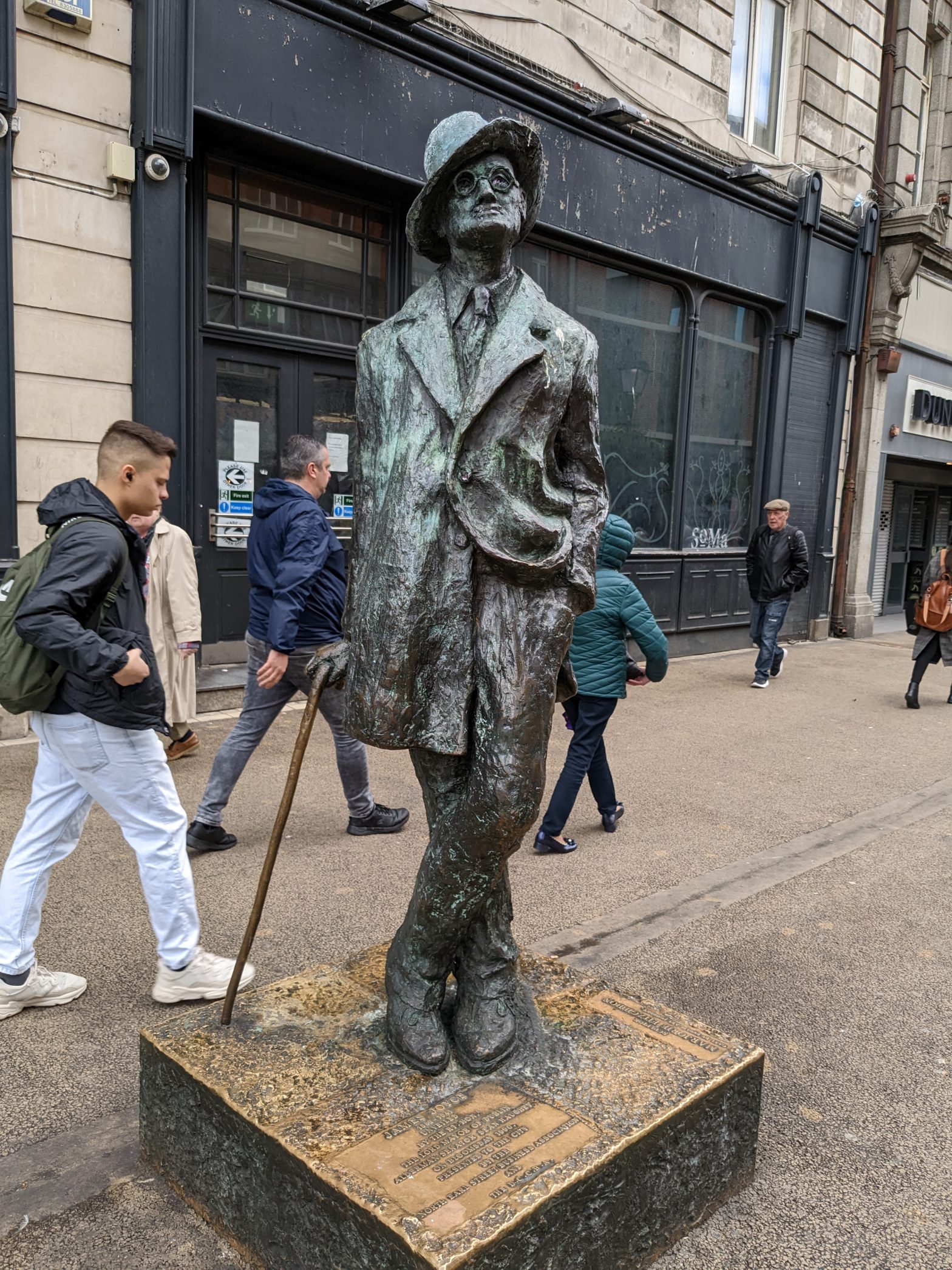
Sheffield to Dublin
Sail-Rail from Sheffield to Dublin – What’s it like?
I got the train to Holyhead on Oct 2nd, the day after a strike, so I was a bit worried that my journey would be disrupted. Although Northern had cancelled the 09:14 stopper, the 09:11 express was running and they even took the time to attach an extra unit. I had time at Piccadilly for a coffee+xant and a comfortable TfW train got me to Chester. It was a very tight connection at Chester – if I had been able to get there earlier I would have : and the 2-car train was very busy, but there was the odd seat & I was able to get a good one with a view after a couple of stops – ideally on this train you sit on the right hand side to get the sea views. At Holyhead, although my ticket said Irish Ferries, Stena Line were happy to take me – imagine rocking up to the Ryanair desk with an EasyJet ticket! I checked in my Brompton – no extra charge for this – and the bus drives you right on to the ferry and soon you’re sitting in a comfortable lounge sipping a tea (other beverages are available) Onwards to Dublin!
I had picked up a puncture on my Brompton somewhere and contacted my pal Damien to see whether he could meet me with a repair outfit. Sure enough he turned up complete with dog, cargo bike and full repair kit – soon we were on our way. An off-road route from the city to the ferry port is being built but not quite ready yet, so we shared the road with a few artics to get out of the port. Obviously we had to stop for a drink before heading home.
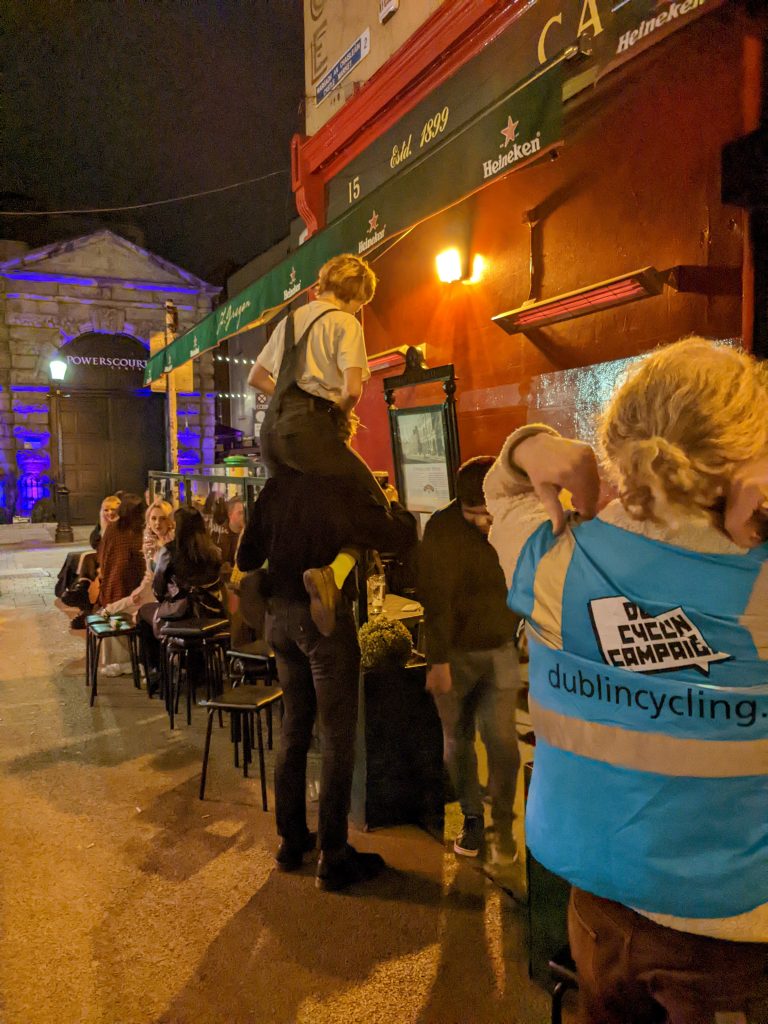
Active Travel in Dublin
There have been a lot of changes in Dublin since I was last there. The tipping point was the Velo-City conference in 2005 which opened up Irish politicians, planners and campaigners to the possibilities. Upcoming at that time was the opening of the tunnel to the Ferryport, which took heavy truck traffic off the Quays and created space for the planners. At that time the Luas light rail system had termini on each side of the city but now it is linked up. Cycle lanes, formerly just white paint on the road, are now becoming segregated, sometines initially lightly with “wands” but increasingly with permanent demarcations. And there are plenty of cyclists about! Dublin is a city of the young with a thriving University culture. Dublin Area Rapid Transit (DART, a nod to the BART San Francisco system, perhaps?) has plenty of room for bikes as does the heavy rail system.
Heading up north to Howth, every main road had a separate, well used cycleway system. Greenways are being built in the city and across the country as well – the Royal Canal and Grand Canal towpaths are very cycleable and Damien took me out to see the new River Dodder Greenway, providing access to the Balrothery Weir, an amazing stepped weir, previously quite hard to find.
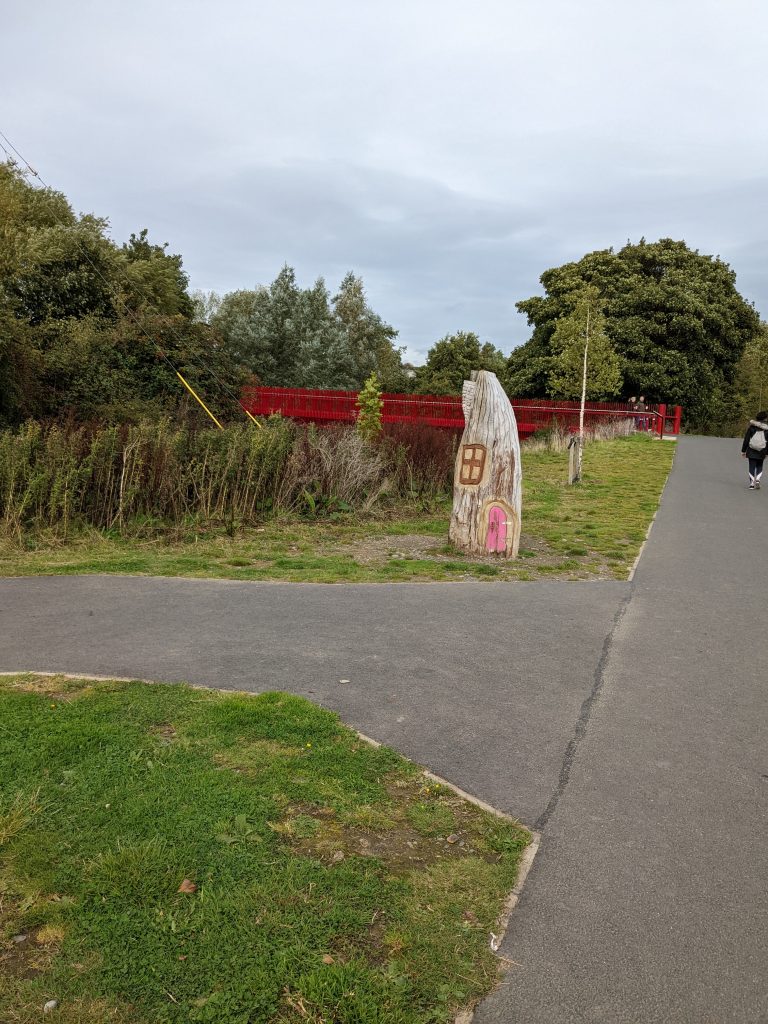
River Dodder Greenway Balrothy Weir 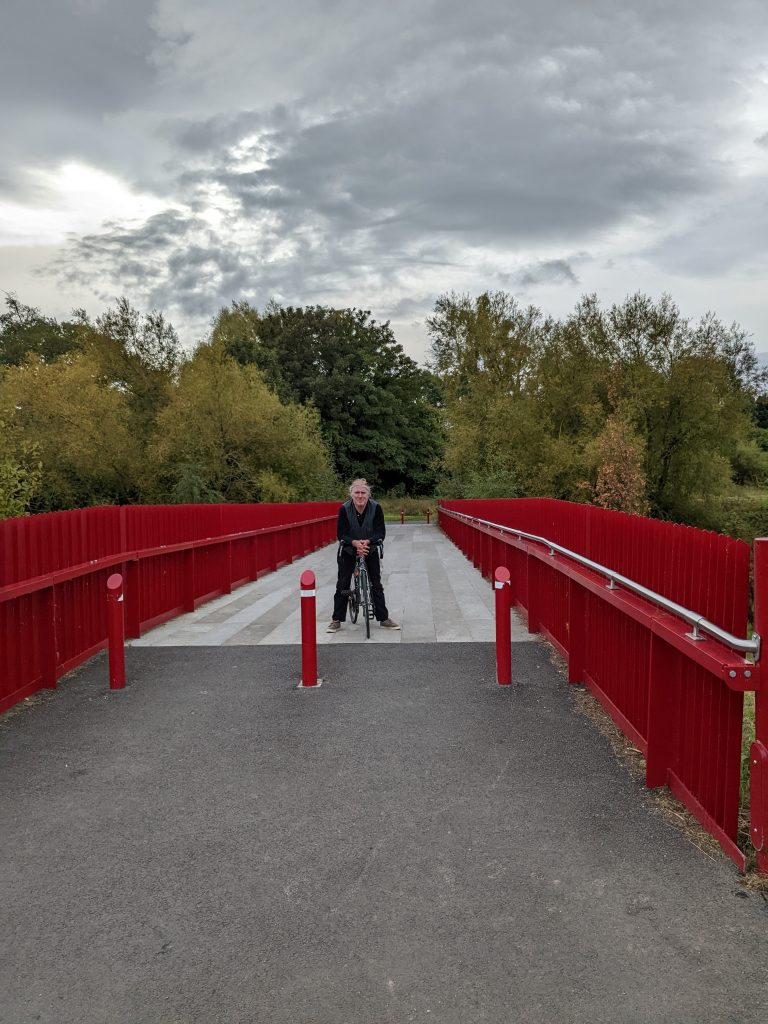
Damien on one of the new Greenway Bridges The investment in all this, coming from austerity-hit Britain, is quite astounding. Unfortunately a side-effect of all this development has been that housing prices have gone through the roof, as everyone wants to live in Eire now.
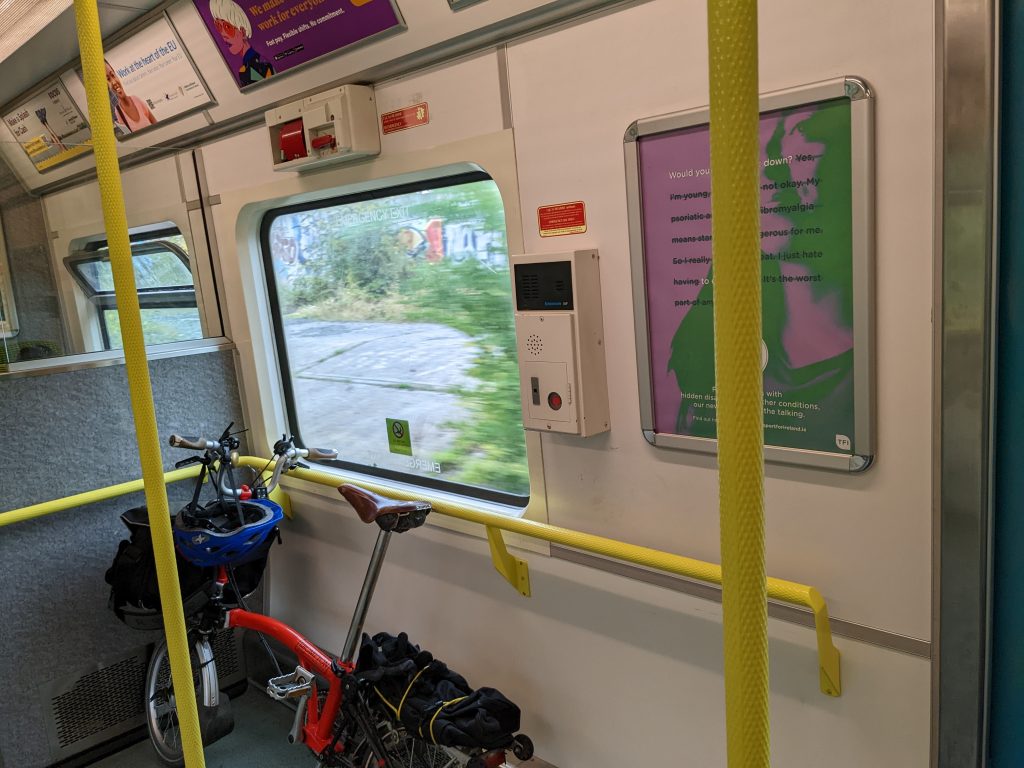
Sadly I had to leave and the sail-rail journey back all went well until arriving in Manchester to find many cancelled trains and everyone heading for Sheffield squeezed onto one Northern Rail stopper. Welcome back to the UK!
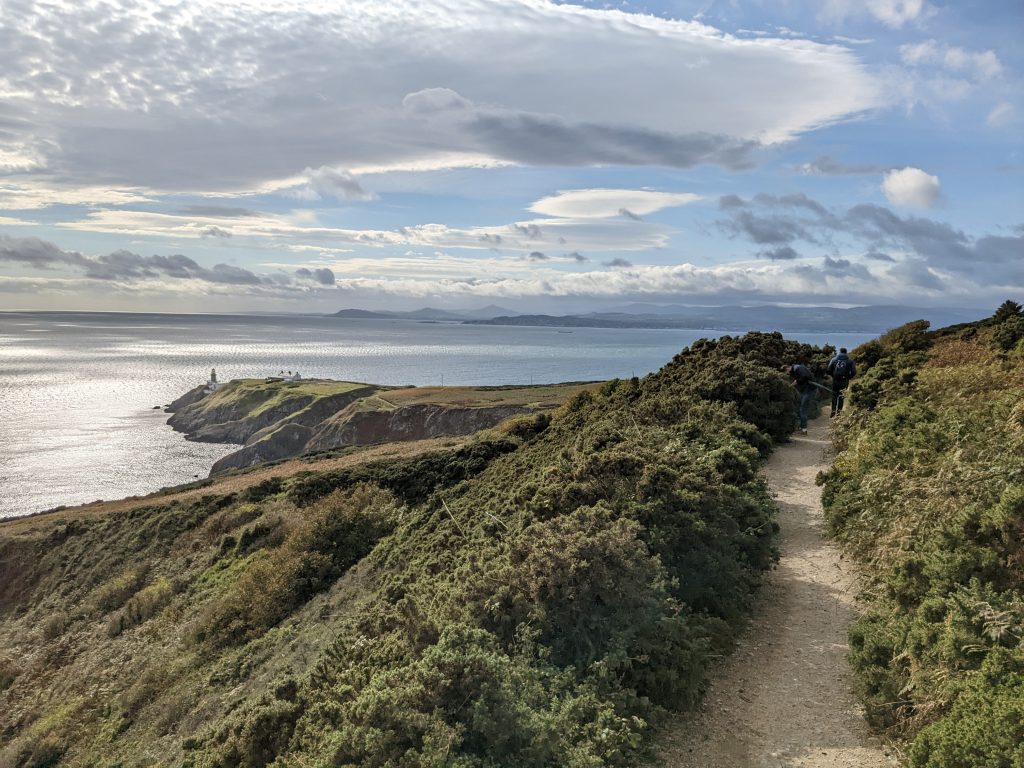
Walking route in Howth -
Transport in France
I was in France for a couple of weeks before the Integrated Rail Plan was launched, so I thought it might be instructive to have a look at how Public Transport works over the Channel.
High Speed Rail
We spent some time in Arcachon, a seaside small town on the Atlantic coast near Bordeaux, where I noted that if I wanted to I could catch the 05:45 TGV service to Paris and arrive at 08:45, in time for a morning meeting or a day’s work – a distance of 646kms. We were in Bordeaux on Sunday evening and noted 3 trains leaving for Paris at the end of a holiday weekend within 30 minutes, each doubled-up TGV units and full – nearly 1,000 passengers per train.
ER train from Arcachon to Bordeaux
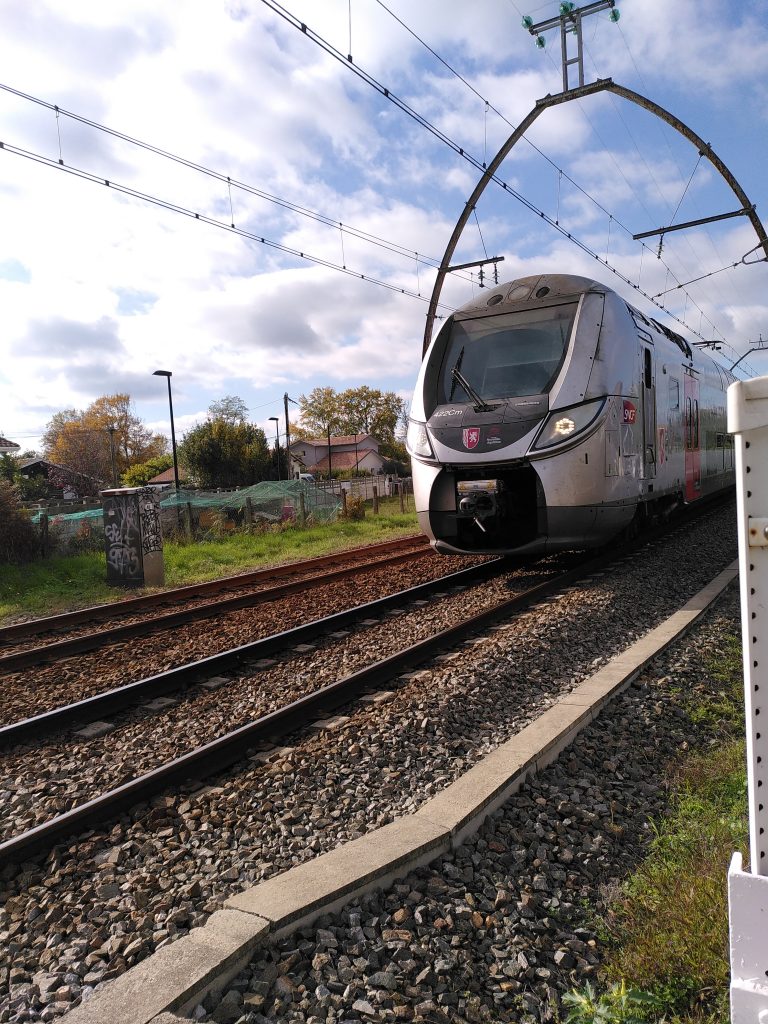
We took the direct TGV from Bordeaux to Brussels, avoiding Paris and changing at Lille for the Eurostar. France is now banning internal flights on many routes because there is no need for this wasteful high-carbon mode of travel. When we got back to the UK we had the choice of a diesel train taking over 2 hours to cover the 165 miles to Sheffield, or a cheaper journey on an electric train, changing at Doncaster. Britain’s failure to invest in rail has left us as a backward-facing, parochial laughing stock in Europe (although the people we met were far too polite to say so) and the HS2 debacle risks making matters worse.
Local transport in Pau
Pau is a smallish city in the Pyrenees region of France (but not in the mountains themselves) having a city population of about 85,000, and a regional population of 200k – so about half the size of Sheffield.
The city centre has a transport problem that is by no means unique to Pau. The station is at the bottom of the valley, with rivers running beside and underneath, and there is a steep climb up to the city centre. Sound familiar? So what has Pau done about it? Well, there’s a free funicular railway – it carries bikes of course, and is used by .5m people per year.
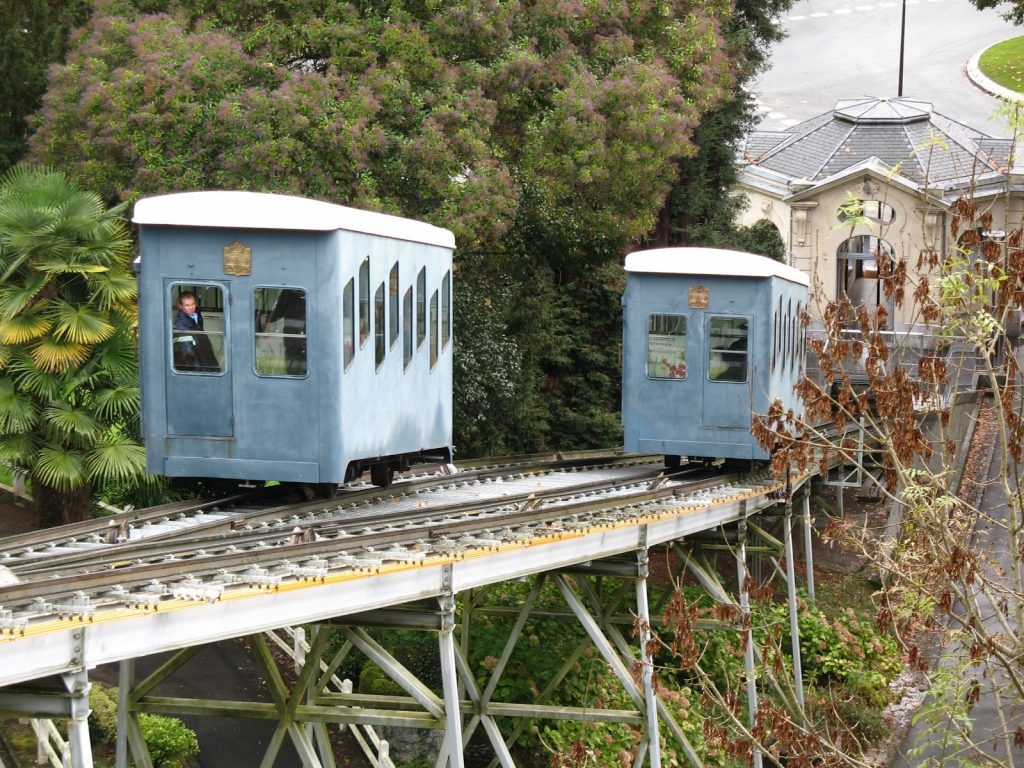
Pau Funicular Once you are in the City Centre, the jolie free electric Navette bus will get you around.
Bikes, electric and normal, are very much in evidence including La Poste’s fleet of E-cargo bikes, – they have at least 5,000 and Project Management types will be interested to learn that they use Lean/Six Sigma to maintain them. Where are the UK Post Office e-bikes?
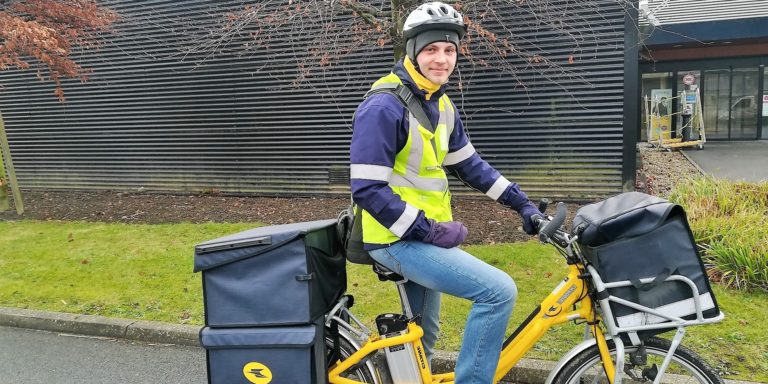
Motor traffic is severely limited and the centre is a thriving, very pleasant place to stroll about, find a cafe, bar or restaurant, etc.
Voie Vertes (Greenways)
France has embarked on a programme of converting disused railway lines into Greenways.
One such runs from Lourdes past Argelès-Gazost to Sonome, where bike paths and quieter roads take you up into the High Pyrenees and the famous cols. The path is surfaced with tarmac and has three types of access control in place:-
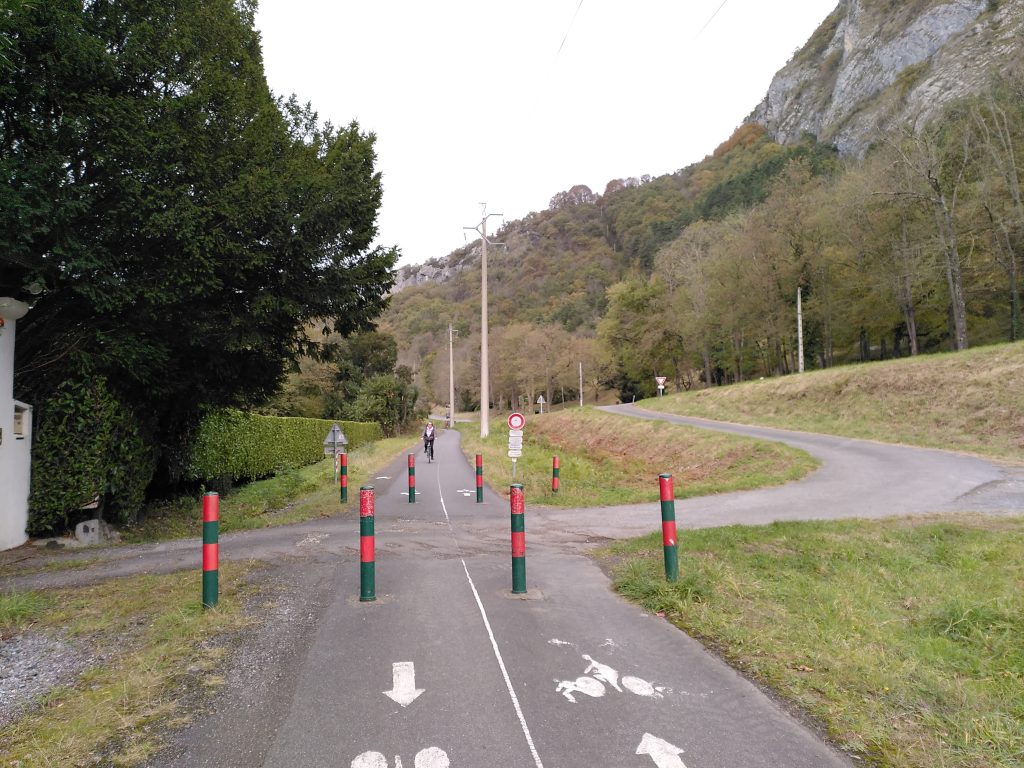
Bollards 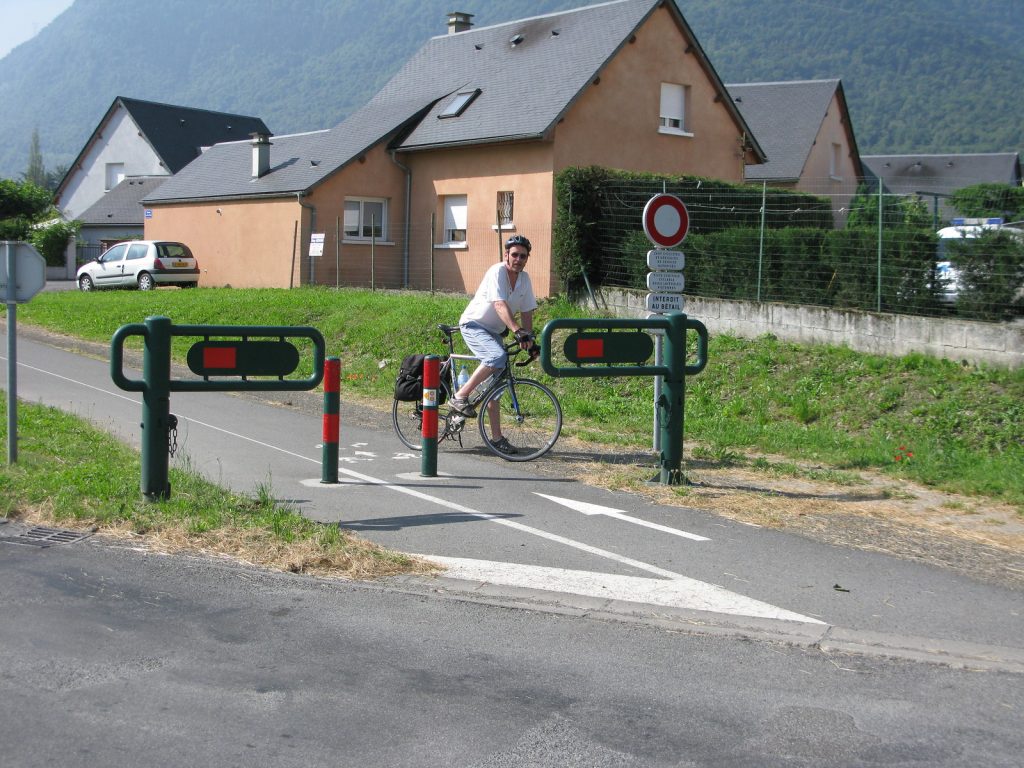
Short Ovals 
Long Ovals All of these seem intended only to slow cyclists down or prepare walkers when there is a road to cross. They wouldn’t keep a motorcyclist out and indeed we saw no motorcyclists on the trail – it doesn’t seem to occur to French motorcyclists to try to use them! We did see La Poste on their e-cargo bikes – great for getting around this mountainous area.
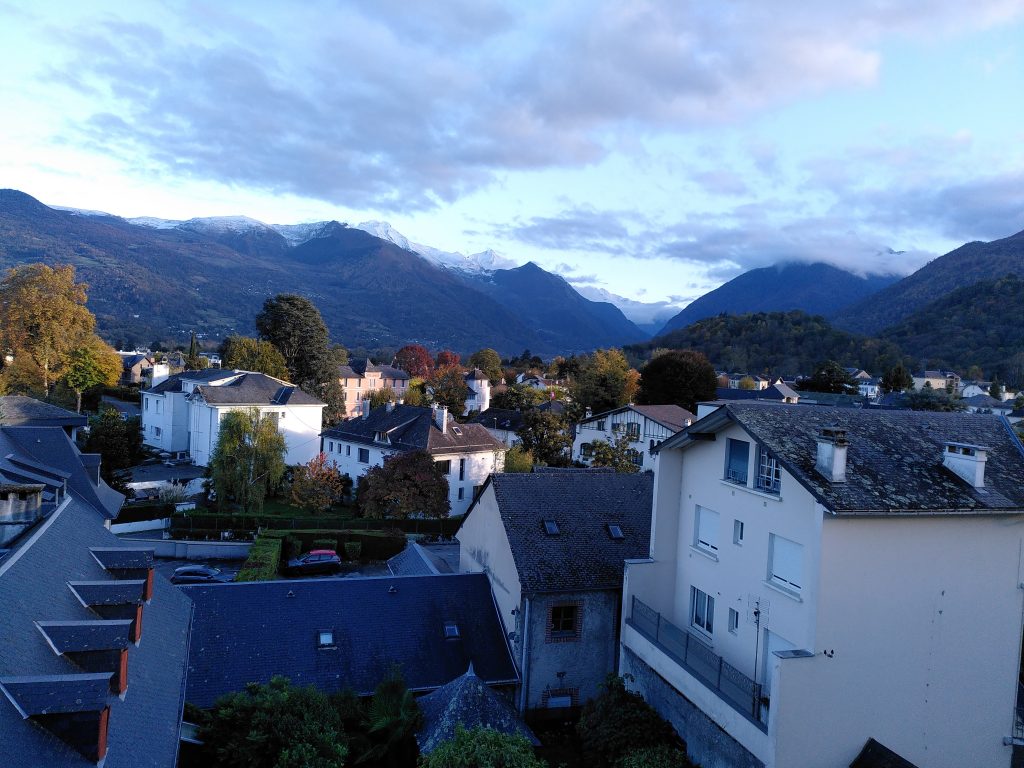
Argelès-Gazost COVID Precautions
France has kept some COVID Restrictions in place. Masks are obligatory on Public Transport and you need a Covid passport, showing that you have been vaccinated twice, to enter restaurants, bars, museums etc. Consequently, as over-65s we felt much safer going into these places and using public transport. The rules were generally adhered to but less so in the quieter town we visited where we felt less at risk anyway. Coming back to the UK it feels like the Wild West where people are completely reckless with their health and that of others. All you can do is get your booster jab and hope for the best!
-
Integrated Rail Fail
So I’ve actually read it, appropriately enough while travelling from Lille to Sheffield via Eurostar/LNER/Northern, I must say that it addresses a lot of the concerns that Greens have had about HS2 – that it has too big a land take, that it doesn’t serve the right places, that the journey time improvements don’t justify the expense, that decarbonising the existing network should be the priority, etc. For the East Midlands, instead of building a new interchange at Toton, it makes use of under-used East Midlands Parkway via a new High-Speed line from Birmingham (So the newspaper headlines that Phase 2b has been “axed” is a little bit inaccurate).
However, the new line won’t go into Birmingham itself so we will continue to rely on Cross-Country for that journey. Parkway stations generate motor traffic, so the prospect that the trains will then be able to access Nottingham and Derby has to be a good thing. Arrival at Sheffield will be at the existing station. The report suggests that journey times would be similar to those predicted via a new High Speed line throughout. There is however a focus on journey times in the report and not much on capacity – if we are to get more freight onto rail we need that extra capacity that HS2 would have brought.
The Midland Main Line will be fully electrified – at last! Much is made of the decarbonisation aspects of this. They suggest that HS2 benefits can be brought to the region much more quickly by this option.The electrification stops at Sheffield though. It will be interesting to see whether the local improvements we have been promised come to fruition – Stockbridge, Barrow Hill etc.
Doncaster, York etc would continue to be served by the ECML which is also to get some upgrades
So not too bad for Sheffield & the East Mids then. Not so good for West Yorks. The report says they will “look at” how the line can best be delivered to Leeds. There was speculation that a high speed line would be built between Sheffield and Leeds (I think most likely via the Dearne Valley) but I have yet to see that in the report.
Leeds is to get, at long last, a mass transit system (the report doesn’t specify whether this will be bus, tram. Metro or something else)
Northern Powerhouse Rail instead of being a network of high-speed routes across the North, becomes an upgrade to the existing route, which was supposed to happen anyway, and the report suggests that under the previous plan they would have just finished that upgrade and then started building another line. Sheffield would have been connected to NPR that opportunity has been lost.
Bradford loses the prospect of a through route under the city, although there was already some controversy over the siting of the station for this. The line from Leeds to Bradford via New Pudsey is to be electrified – I’m not sure what benefits that brings, since the trains using that route continue to Manchester via the Calder Valley and I’ve seen no hint that line is going to be electrified.
Manchester & the North-West pretty much get what they were expecting but the Mayors have been good enough to pile in to support those areas that are losing out.
So what do the pundits say? Christian Wolmar grudgingly seems to admit that it’s a pretty good plan, but doubts that we can trust Boris to deliver it, with some justification I feel. Paul Salveson thinks that HS2 is fundamentally flawed anyway, mostly for being too London-centric However, we can blame the Romans for Britain having a London-centric transport system and that isn’t going to change anytime soon. Nevertheless, Northerners are seeing this as another betrayal from a government of serial liars who were never serious about “levelling up.”
-
E-Bike page updated
Our e-bike page is updated monthly with all the latest info. Visit Now! Electric bikes (e-bikes) explained
-
A Long View of Longdendale
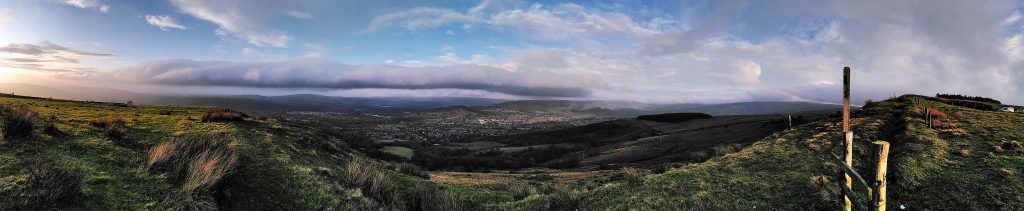
Glossop from Slack Edge I was a latecomer to car culture, and still not that keen on the metal boxes so I’ve been attempting to get across the Pennines by bike or by public transport ever since I arrived in Sheffield in 1974.
I don’t think I ever got the chance to travel across the Woodhead line – I did go on a Charter train to Blackpool in the 1970’s which headed north from Victoria but I think it went via the Calder Valley.
Then, when I worked for a travel company in the 80’s we had an arrangement with a bus company who ran direct services to Manchester Airport – this was before the rail link was built – so used that a few times. I have a vivid memory of coming over the Woodhead and the spectacular view somewhat marred by pylons everywhere and of course the glowering skies meant you were west of the Pennines. And I’m very pleased to see that Hulleys are now running a bike-carrying bus service over the Snake but haven’t used that yet. (This service didn’t survive Covid unfortunately)
Occasionally in those days we would go to a concert in Manchester – it’s always had a better entertainment scene than Sheffield – and we would normally pile in a car to get over. It’s always been a difficult journey in winter but in those days there wasn’t the congestion around Mottram we see now. Now, there is normally a late train back but it goes a roundabout route to avoid potential engineering works and doesn’t run on Saturday nights so going to a concert often still involves travelling by car.
In terms of getting back from Manchester airport, the journey was a pain without a car. Arriving from a foreign bike tour, I would re-assemble my bike, cycle to Gatley and get a train to Piccadilly. From Picc back to Sheffield, if it was the first train in the morning, it would only get you as far as New Mills where you would sit around on a cold platform until another elderly DMU fired up from where it was hidden in the tunnel that was all that remained of the line to Hayfield (from where the Kinder Trespassers set off) and chuntered back stopping at all stations through the Hope Valley. Quite a tiring end to a journey that had started at midnight in Corfu airport!
With improvements to the Sheffield- Manchester service and the Trans Pennine Trail open, more journey opportunities opened up. I’ve done several trans-pennine journeys either travelling to Stockport, or to Manchester Airport (it’s only a few miles to the TPT) and cycling back to Sheffield via the Trail. The TPT is of mixed quality along this stretch, but Tameside country park and the Hyde Greenway are good. Subsequently you have a couple of stiff climbs on rough tracks and sections on main roads before you drop down to Glossopdale (an alternative might be possible via Gamesley sidings) where you cut through some housing before another on-road section to Hadfield. Here there is a lengthy detour via Tintwhistle which I can’t see the point of so I head for Hadfield station where I can get on the Longdendale trail. The surfaces on this aren’t brilliant but it’s far preferable to the alternative of the A628 or even the A57 via Glossop. If I was travelling across by bike on-road I would go via Chinley and Rushup Edge.
When we did the TPT from coast to coast we stayed in Glossop and found that it was a pleasant country town, far different from what we expected. We found a pub with unfeasibly cheap beer and had a very good Sri Lankan meal which was unexpected! Some members of the party stayed in Hadfield and found the train link very useful.
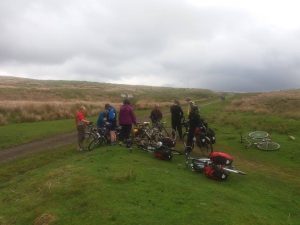
Intrepid Riders on the Woodhead Further east at Torside, we are implementing accessibility improvements to the trail and the National Grid are undergrounding cables which will improve the visual amenity immensely.
There has been talk of opening one of the tunnels for cyclists, but with high-voltage cables installed this would be expensive and I can’t see it happening. The same argument applies to re-opening as a rail tunnels and they may not even be suitable for a modern high-speed railway such as HS3. Plus I think the Peak District needs a rest from development – we need it as a haven for our under-stress wildlife, not as a high-speed corridor between cities. Other routes are available.
Be that as it may, getting up onto the moors at Ironbower is a challenge – it is practically impossible to cycle up the steep track (Danny McAllister might be able to do it) although not that far to push. There is a gentler gradient from Woodhead Bridge but getting there entails a lengthy ride along the A628 unless you have come from Holme Moss, and the bridleway has a poor surface.
Subsequently you have two crossing of the A628 to negotiate before you can descend to Dunford Bridge where the Trail improves a lot.
Rail – getting to Glossop or Hadfield is a lengthy trek from Sheffield involving travelling via Man Picc. Re-opening the railway would make that easier but (a) there would either not be a trail to travel on, or it would be a less pleasant experience being next to the railway (b) I’m against it for the reasons stated above. Bike-carrying buses would seem to me to be the solution here.
Driving
My main purposes in driving this route have been (i) getting to the airport, usually to pick someone up or drop them off (ii) Going to North Wales (we used to use it also to get to West Wales but it is now quicker to go Derby & the M6 toll) via (iii) dropping off/picking up daughter at Uni in Manchester. I live close to the A57 in Sheffield so usually go across the Snake.
We are all well aware of the congestion problems at Mottram and I often turn left at Glossop and go via Charlesworth & Broadbottom (I know this route well from having used the TPT) This probably doesn’t save me any time but I prefer not to be sitting in a polluted traffic queue and it has stunning views.
I think that the traffic problem could be solved by some smart traffic modelling rather than building new roads, for example:-
Some of the vehicles are airport traffic that could and should go by rail.
A lot of the HGV traffic is travelling from Ireland to the East Coast ports and onward to Europe – why would we invest to facilitate this post-Brexit? It seems that this traffic might anyway divert to direct ferries to Europe, to avoid the new paperwork that is required and delays this will cause.
Then, a proportion of the traffic is light delivery vans travelling from distribution warehouses in Manchester to Yorkshire – the logistics industry could avoid this by reorganising their delivery patterns. As a Sheffield resident we are concerned about the additional traffic going through Broomhill and making it easier to access the Snake Pass is likely to increase this.
I think that Highways Agency are being disingenuous about this and either have not done their homework or are not putting it in the public domain. If the road does get built, however, I would like to see the best possible Active Travel facilities built into it.
-
Sheffield to Norfolk
Sheffield to Great Massingham Day 1. Train to Kiveton (brand new, sparkling clean) then on NCN6 through Workshop to Clumber Park which was gorgeous. Clumber bridge was severely damaged by an arsehole in a car but has now been repaired and closed to traffic – hopefully it will stay that way. On to 642 through Tuxford and across the Trent on the Fledborough viaduct, continuing through on 64 to Lincoln where we have a fab view of the Cathedral. Yes it is possible to have fun despite everything!
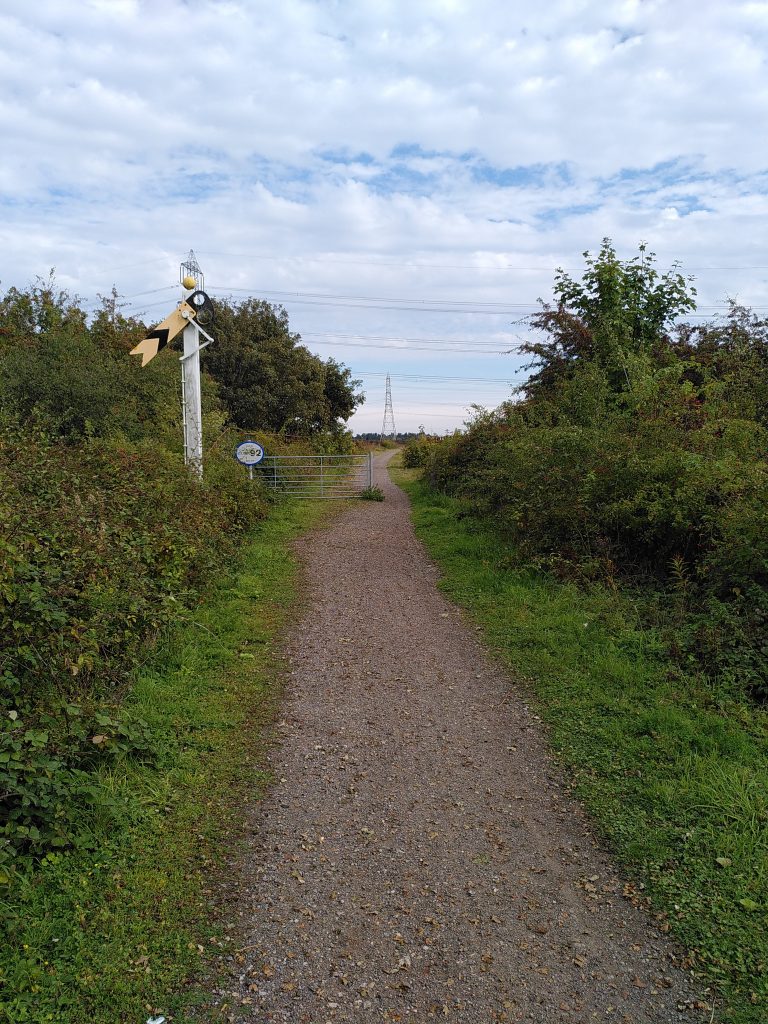
Signal is down for approach to Fledborough viaduct. Sheffield to Walsingham Day 2: Lincoln to Holbeach. Down the Water Rail Way (it’s a triple pun: it’s an old railway path running between two watercourses & the water rail (bird) lives there. Geddit?!) along very long straight roads, got lost in Boston (always do) & then along remote washlands roads into Holbeach. All on NCN1.
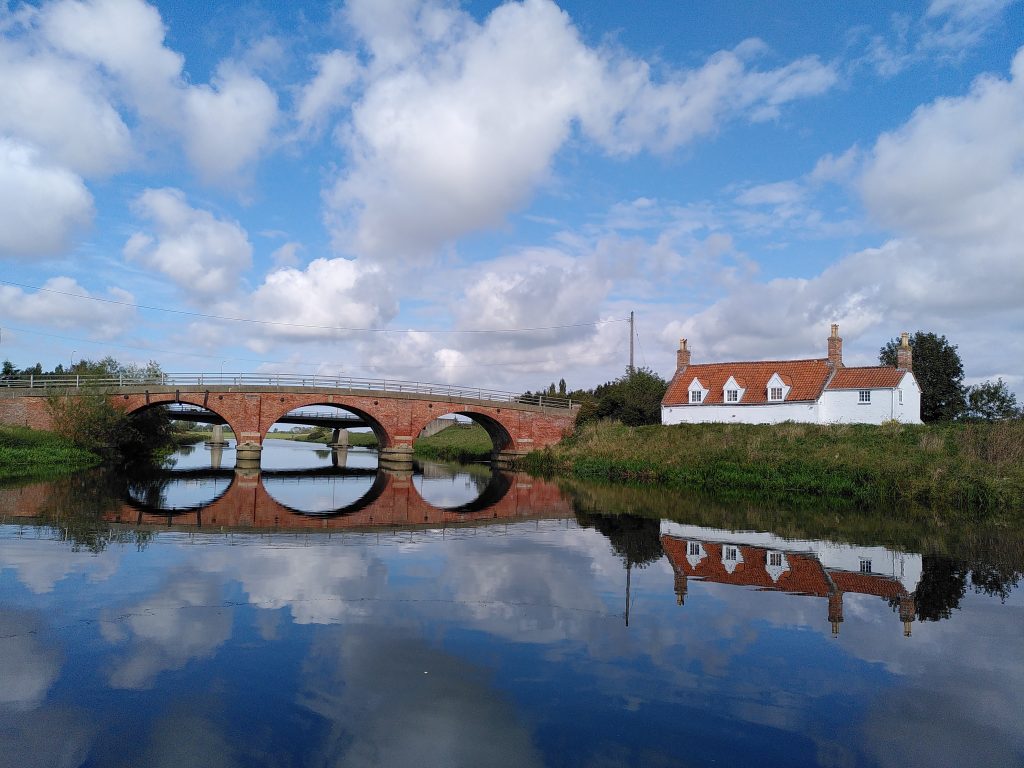
Tattershall Bridge Sheffield to Great Massingham Day 3. We left our lovely hosts in Holbeach, still feeling a bit bloated after Adnam’s beers in the Horse and Groom and a massive curry in the Chameli, and continued on our way Eastwards. NCN1 veers south at this point towards Wisbech, so we left it behind and continued on slightly busier roads through Gedney to Long Sutton (passing the Jolly Farmer…
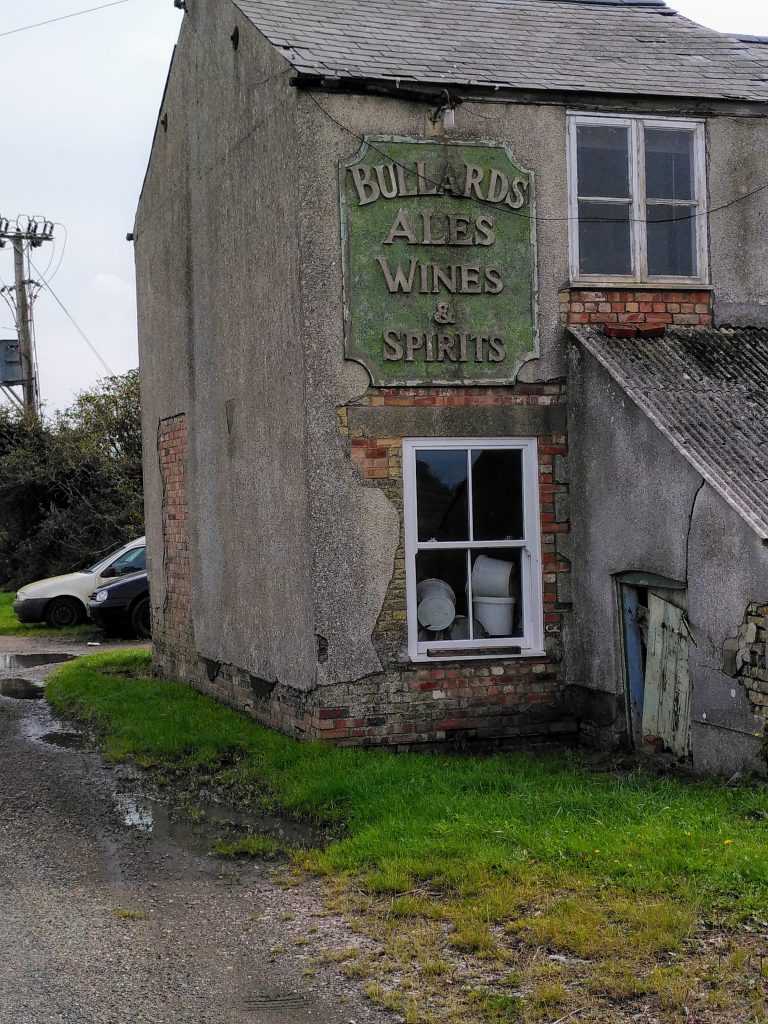
Not so jolly… where you cross the Nene and continuing to Terrington St Clement where we veered south, rejoining NCN1 at Wiggenhall St Mary Virgin to cross the geographical barriers that separate the Fens from Norfolk – the Middle Level Main Drain, the Great Ouse, the Relief Channel, the railway, the A10 and the A47. The landscape is changing – the odd rise, more trees – as we made our way to Marham, noting that now even the minor roads can be busy, on to Narborough. A refreshing climb up Tumbleydown hill brought us to within quacking distance of the Dabbling Duck, which was to be our home for a couple of days while we visited the Anish Kapoor exhibition at Houghton Hall before making our way to Kings Lynn for trains home. NCN1 from Castle Rising is a fantastic way to journey right to the heart of the city, notwithstanding Sir John Betjemans lament for the demise of the Kings Lynn to Hunstanton railway.